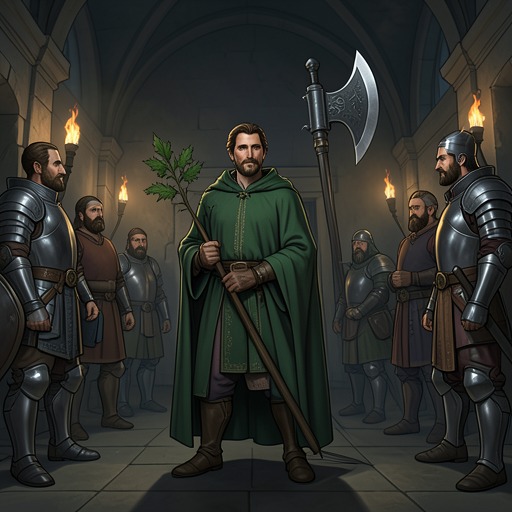
Green Knight's Beheading Game
Sir Gawain and the Green KnightThe Green Knight's Beheading Game begins as a Christmas entertainment at King Arthur's court but becomes a year-long trial of Sir Gawain's courage and fidelity to his word. Its startling terms make the apparent victory of the first blow inseparable from the obligation to return and face its answer.
Christmas Challenge and Terms
At Camelot, the Green Knight presents the proposed encounter as a Christmas game and challenges the court's reputation for boldness. He offers his axe to the participant who will strike him, while the arrangement gives him a later claim to an answering stroke. The proposal makes the court's festive display of courage carry a real consequence: whoever accepts must trust that the challenger will survive and keep the terms.
Gawain Accepts and the First Blow
King Arthur orders Sir Gawain to rise, and Sir Gawain approaches the Green Knight with the axe in his hand. The Green Knight recognizes that Sir Gawain has accurately restated the terms, binding the courtly exchange to the challenger’s promised return. Sir Gawain then strikes: the blow severs the Green Knight’s head and sends it to the ground. What looks like a decisive victory is only the first half of the bargain.
The Green Knight does not die. He sets himself upright, retrieves his head, and holds it aloft as he reminds Sir Gawain to be ready to go as promised. He directs him to seek the Green Chapel and come there on foot to receive the answering stroke. The returned head turns the game’s apparent impossibility into an active obligation: Sir Gawain must leave the safety of the court and meet the consequence he accepted.
The challenge’s timetable stretches the scene into a test with a fixed future endpoint. After Christmas comes Lent, and the promised meeting remains ahead; later, as Sir Gawain rides through the wilderness, the search for the Green Chapel gives the court’s festive wager the shape of a perilous journey. The Green Knight’s survival has therefore changed the meaning of the first blow: courage is no longer measured by striking, but by keeping the appointment after the spectacle has ended.
The Appointment at the Green Chapel
When Sir Gawain finally meets the Green Knight, the challenger marks the encounter by recalling its exact interval: a twelvemonth has passed since Sir Gawain delivered the blow at court. The reminder measures the game not by the force of that first stroke but by the time kept between promise and answer. Sir Gawain has arrived at the appointed place, and the Green Knight’s greeting makes the return itself part of the reckoning.
The Green Knight now takes up the role Sir Gawain had accepted for him: he is to answer the earlier stroke. Yet the exchange is no longer the court’s public Christmas spectacle. At the Green Chapel, the original terms are tested against what has happened during the intervening year, and the challenger prepares to explain the encounter truthfully. The game’s final meaning therefore depends on more than whether Sir Gawain can endure a blow: it depends on how faithfully both parties have understood and kept the bargain.
The Game as Arthur’s First Adventure
The poem frames the challenge not only as a test imposed on Sir Gawain but as an adventure offered to King Arthur: the narrator calls it Arthur’s first such gift. That framing enlarges the stakes beyond the axe exchange itself. A Christmas game becomes the opening adventure of the court’s story, while its delayed answer carries the test out of the hall and into the year that follows. At the Green Chapel, the Green Knight’s promise to tell the truth signals that the encounter’s explanation, as well as its physical outcome, belongs to the game’s reckoning.